Impact
Selected Media Coverage
‘Better and cheaper’: the case for prostate cancer screening among Black men
The Guardian – Tobi Thomas, 17 November 2025
Feature discussing the case for targeted prostate cancer screening in Black men, highlighting our perspectives alongside patient advocates.
Together against prostate cancer - How a partnership of scientists, patients and industry could transform prostate cancer care
University of Cambridge, 13 August 2024
Feature on how collaborations between our researchers with patients, charities and industry in Cambridge are reshaping prostate cancer diagnosis and treatment.
Cancer signs could be spotted years before symptoms, says new research institute
The Guardian, Robin McKie, 31 March 2024
Article exploring how early-cancer research – exemplified in the launch of our new institute – aims to detect cancer years before symptoms appear.
An awakening in next-generation molecular diagnostics
Nature Research, 11 August 2022
Insight piece on our use of emerging molecular diagnostic technologies and how they are changing the way we detect and monitor cancer.
Cambridge BRC scientists report promising new findings on early use of targeted therapy in prostate cancer
NIHR Cambridge Biomedical Research Centre – 17 June 2025
News story on our early clinical findings suggesting that targeted therapies may benefit some men with prostate cancer earlier in their disease course.
Protein discovery may reveal why some patients develop resistance to new classes of anti-cancer drugs
Tech Exploits, 25 July 2018
News item describing how our newly identified protein complex may explain why some cancers stop responding to targeted therapies.
New blood test could diagnose prostate cancer more accurately
The Telegraph – Laura Donnellly & Rosie Taylor, 12 January 2026
News report on our blood tests that aim to diagnose prostate cancer more accurately than current PSA-based approaches, and what they could mean for future screening.
Breakthrough blood test could detect cancer killing more than 12,000 each year
Mirror – Samantha Leathers – 13 January 2026
Article highlighting research into our “breakthrough” blood test that could detect cancer at an earlier stage and potentially reduce the need for invasive diagnostic procedures.
Selected International Presentations
Epigenetic Drivers of Localised Prostate Cancers Reveal Neuronal Plasticity and Microenvironmental Reprogramming and Inform Liquid Biopsy Biomarkers
Early Detection Cancer Conference, Portland, USA - 2025
Identification of rare cancer-associated epialleles in plasma cell-free DNA enables early detection of prostate cancer and treatment monitoring
CNAPS, Hong Kong - 2025
Widespread methylation convergence in clonally distinct foci of multifocal prostate cancer
AACR Special Conference “Cancer Evolution: The Dynamics of Progression and Persistence”, New Mexico, USA - 2025
Pre and post treatment transcriptomic analysis provide new insights on the mechanisms underlying the efficacy of PARPi and androgen blockade in prostate cancer.
AACR Special conference on DNA Damage Repair, Washington USA - 2024
Identification of rare cancer associated epialleles in plasma cell free DNA enables early detection of prostate cancer and treatment monitoring.
Genome Science UK, Newcastle, UK - 2025
Early detection assay using ctDNA methylation for hard-to-detect cases including prostate and renal cancer.
European Association of Urology Annual Congress. Milan, Italy - 2023
-
Funders
Our work is made possible by competitive funding from UK and international organisations, covering basic discovery science, translational projects and trial-linked studies. Between 2020 and 2025, these programmes have invested more than £5 million in our research, with contributions approximately proportioned as shown.
-
Cambridge Biomedical Campus
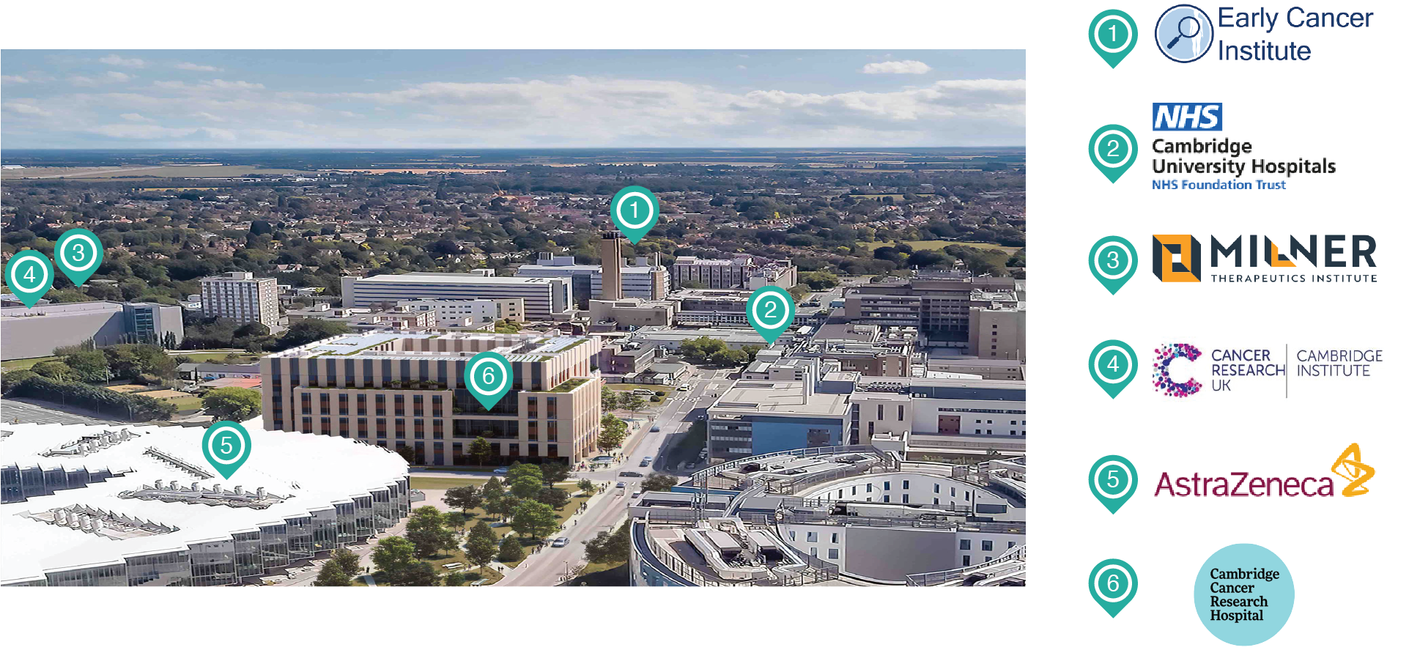
We are based on the Cambridge Biomedical Campus, at the centre of a dense network of partner organisations that make our research possible. The map highlights the research institutes, hospitals and industry sites with whom we work day-to-day to conduct our research, deliver trials, collect samples and translate discoveries into practice.
-
External partners
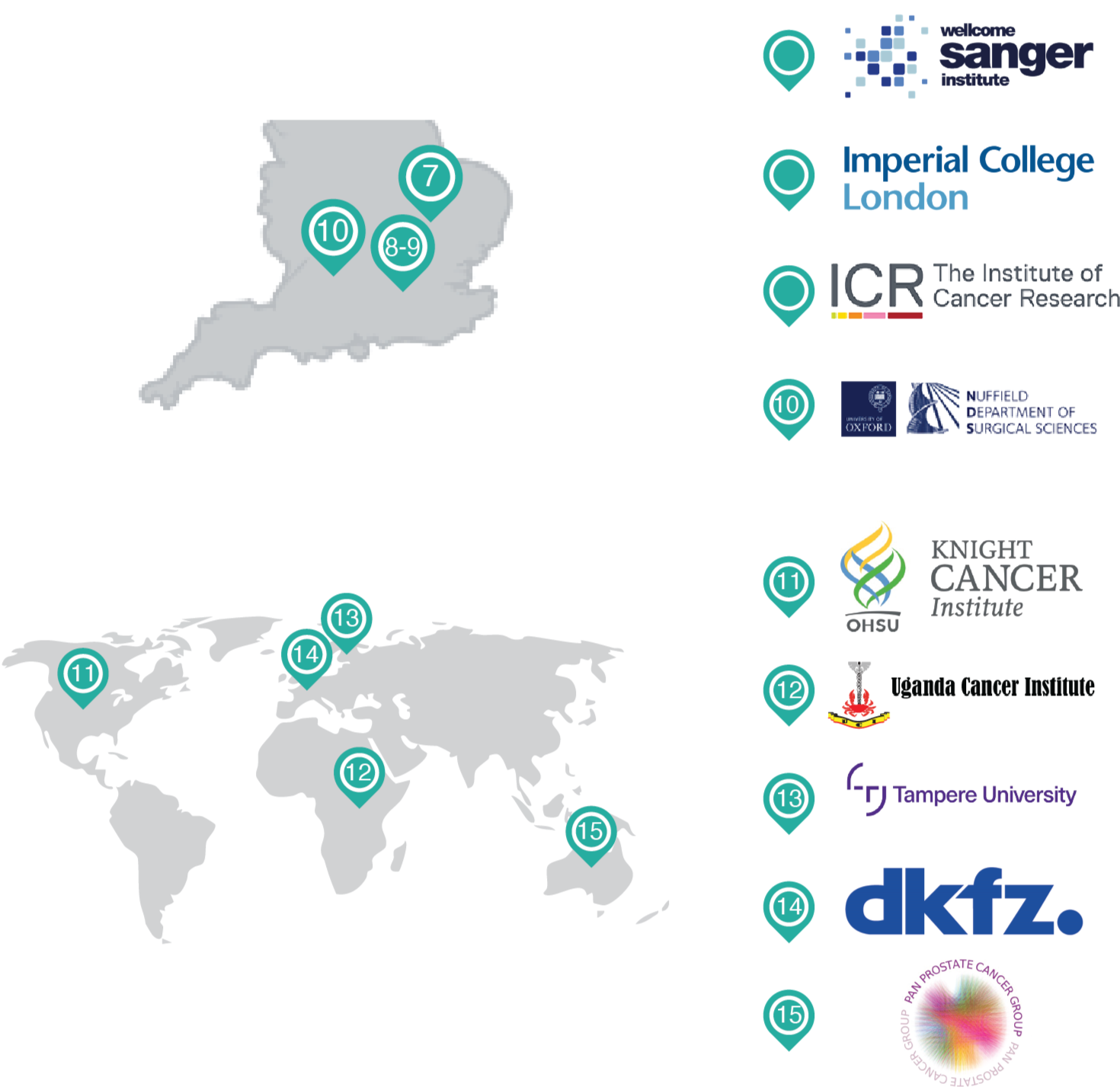
We are fortunate to work with external partners across Europe, North America and beyond, spanning fundamental science, translational research and clinical trials. The map highlights some of the academic, clinical and industry collaborators who help us tackle shared questions in early lethal prostate cancer.